Five minutes with Asher Abergel
Published
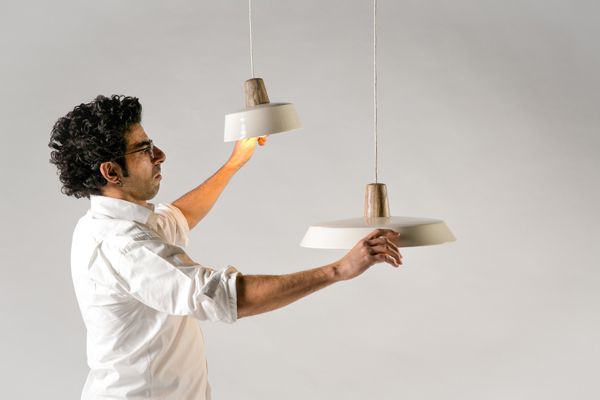
We take five minutes to chat with industrial designer, Asher Abergel.
Name: Asher Abergel
Occupation: Industrial Designer
Location: Sydney
Company: Dezion Studio
Position: Founder/designer
The moment you knew you wanted to work in the design industry.
It was while I was working on my final project at university, when I realised that designers can change the world, or at least how people relate to the world around them, through the objects that surround them. It sounds like a big statement, but think how Apple, for instance, changed the way we perceive the world through its design.
How did you come to be a designer? What first drew you to the practice?
I used to draw and paint from a very early age. I was also very curious about how things worked, which mainly translated into me taking apart my toys or my mother’s kitchen appliances much to her dismay (I wasn’t always that great at putting them back together again). But it was at a university open day, that I discovered this thing called industrial design, and I realised I could meld my passion for art, love of aesthetics and pursuit of functionality. I really enjoyed what I studied and was drawn to the industry.
What interests you most about this particular field of design.
Lighting and furniture design interests me because it is very basic. A table, chair and lamp are the bare essentials of modern living. Nevertheless, designing a good chair or lamp is still challenging, there are millions of them out there and designing something worthwhile that stands out is not easy.
What has your experience with education design been?
I studied Industrial design at Bezalel Academy of Art and Design in Jerusalem, Israel, where I grew up. The Academy is a great place to study, and one of the best in the region. We spent a lot of time designing with total freedom; we didn’t have to consider market demands, supply chains or production costs which made the design process purely creative. I always try to maintain this untouched creative process, even though I work to market demand and budget restrictions, which I try to meet without killing the creativity.
The most unusual/interesting thing about the way you work.
I sketch a lot. On the bus, last thing before going to bed and with my morning coffee. Most of the time I try to solve a technical problem through sketching or “visually record” design ideas, but many times it’s just an interesting face, an architecture feature or a tree bark formation which caught my eye. The result is a very messy sketchbook.
Which items in the workplace can you not live without?
Masking tape. There isn’t a single day when I don’t use it and it has hundreds of uses. I always have a few rolls in different widths and colours.
Favourite material.
I love working with wood and plywood. Nothing beats the feel and smell of working with solid timber, while plywood offers a great deal of design opportunities. I also like working with ceramics. That’s pretty much my material palette at the moment.
Favourite local landmark/building.
The Harbour bridge. I can’t stop being amazed by this enormous steel structure. It blows me away to think how they designed and built it back in the days, and had the vision to create a global landmark for the generations to come. I always choose the bridge over the tunnel when heading north!
Favourite international landmark/building.
There are many, but if I need to pick one it would be the Pompidou centre in Paris, by Piano and Rogers. I admire how the building’s appearance was determined by the function it was meant to serve. It is “form follows function” at its best.
Biggest career moment.
Last year I supplied some 60 light fittings for the food court at the new Macquarie shopping centre. It was the biggest fit out I have done to date and when I said “yes” I had no idea how I was going to do it. But I did! My KAV lights are hung there, hand made, one by one, at our Darlinghurst studio, completed on time. I gained a lot of confidence regarding the production process and my capabilities.
Concern for the design industry in the coming decade.
The so called “replica” industry is a big concern. It’s a multimillion dollar industry which enriches the owners of off-shore factories instead of fostering local talent. The educational message here is that the original work is worthless and it OK to copy it. The weird thing is that it’s legal and replica ads are on the newspaper front page. People think that if the word “replica” is attached to a product it indicates some sort of endorsement by the original designers, which is incorrect.
See Asher Abergel’s work at Sydney Indesign 2015.
Related Articles
Events
A rollicking good story with Richards Stanisich and Royal Oak Floors
Jonathan Richards and Kirsten Stanisich discussed practice, design process and the business of running a studio at a live audience event hosted by Royal Oak Floors in Sydney.
Events
Indesign x Wilkhahn: Melbourne, where are you working?
Our latest collaboration saw a range of designers come together at Wilkhahn’s Melbourne showroom for a discussion on the workplace dynamics specific to the Victorian capital.
Events
“A journey into a whole new material world”: Plant Life at the NGV
Curator Ewan McEoin tells us about the NGV’s new exhibition on plant-based materials as alternatives to plastics, synthetic materials and other non-renewable resources.

Events
The inaugural Coastal Design Assembly is about to make landfall in Sydney
Sophie Lanigan, organiser of a new event centring on Sydney’s relationship to water, tells us what the event’s all about, who it’s for and why it matters today.