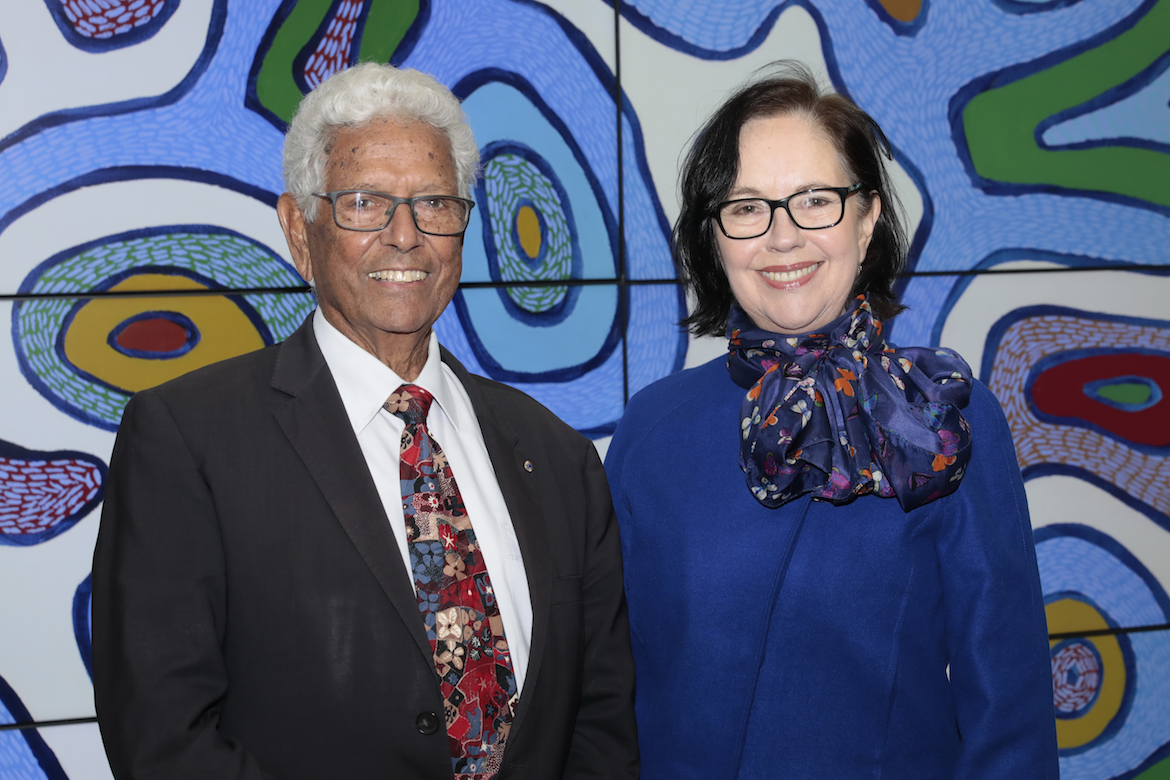
Combining Aboriginal culture, art and the built environment, induction to the AGDA Hall of Fame recognises Ros and John’s significant contribution to Australia’s graphic design excellence.
After almost four decades of focusing predominantly on art and design, Balarinji has more recently begun working in the built environment to address the missing Aboriginal facet in much of Australian architecture.

A Qantas plane donning Balarinji’s Wunala Dreaming
“The Aboriginal narrative is largely missing from Australia’s public places and buildings,” says Ros, who acts as managing director, and John as cultural director.
“It is more common to see Aboriginal elements integrated into precincts of art installations or in Aboriginal-influenced landscape design than in built form.”
Balarinji actively brings the Aboriginal narrative to the built environment by engaging with projects from inception. Through projects like Transport for NSW’s M12 motorway in Sydney, Balarinji has been able to embed First Nation’s design principles early in the project, along with a deep engagement from local Aboriginal communities.

Transport for NSW’s Balgowlah noise wall, by the late Yaegl woman Jessica Birk and Balarinji
“What makes this project special, and many others that Balarinji has worked on, is the authentic connection to Place and Country in a way that celebrates and deepens the understanding of a site’s deep Aboriginal story,” they say.

Redfern Station
“It is what we strive for in all our projects, like Redfern Station’s improvement works, the current Pacific Highway upgrade, and others in Sydney that are currently underway.”
For the Redfern Station improvement, Balarinji engaged local artists and community organisations to create key themes that guided the site’s art.

Cleveland Street Bridge artwork in Redfern by Gadigal artist Nadeena Dixon and Balarinji
This community consultation is a strong part of Balarinji’s best practice methodology, to achieve “deep and authentic community collaboration and co-design with Aboriginal Elders, storytellers and stakeholder groups,” they say.
Currently, Balarinji is working on Mirvac’s 55 Pitt Street redevelopment, GPT/AMP’s Cockle Bay Park redevelopment and the Macquarie Group’s Martin Place Metro Station development, all in Sydney.

Burwood Brickworks‘ ceiling, by Wurundjeri, Dja Dja wurrung and Ngurai illum wurrung artist, Mandy Nicholoson and Balarinji
The company’s ethos “to contribute to an authentic national identity by deepening the understanding of Aboriginal Australia”, has been unwavering for the past four decades.
Ros and John see the philosophy, which was deeply inspired by John’s history and the Moriarty family life, as “more than a company value”.
Rather, their drive to share stemmed from a desire to celebrate their children’s belonging and grew to be a statement of identity for all Australians.

Ballina Service Centre Bundjalung artist Marcus Ferguson and Balarinji
John was born in the late 1930s to a Yanyuwa mother and Irish father in the Northern Territory community of Borroloola. At four years old he was taken from his home as part of the Stolen Generations, the government strategy assimilating paler Aboriginal Children. Only at the age of 30 was John able to reunite with his family, culture and Country.
Ros grew up in Tasmania and on family visits back to Borroloola began to understand the deeper meaning of Country to First Nations people.
“Balarinji was born from our desire to celebrate our children’s belonging to John’s Yanyuwa people as well as to mainstream contemporary Australia,” say the founders.
Balarinji