The home of architecture and design in the Asia-Pacific
Get the latest design news direct to your inbox!

Get the latest design news direct to your inbox!
A new app has been unveiled by the Australian Institute of Architects, providing a glimpse of what Australia has in store for the 14th International Architecture Exhibition – la Biennale di Venezia.
April 4th, 2014
The innovative technology behind Augmented Australia 1914-‐2014, curated by felix._Giles_Anderson+Goad, is now available for the public to download and preview select projects, before the exhibition officially kicks off in Venice this June. The app has been developed to take users on a virtual journey through some of Australia’s most intriguing unrealised projects, incorporating three-‐dimensional (3D) augmented models, images, voiceovers and animations.
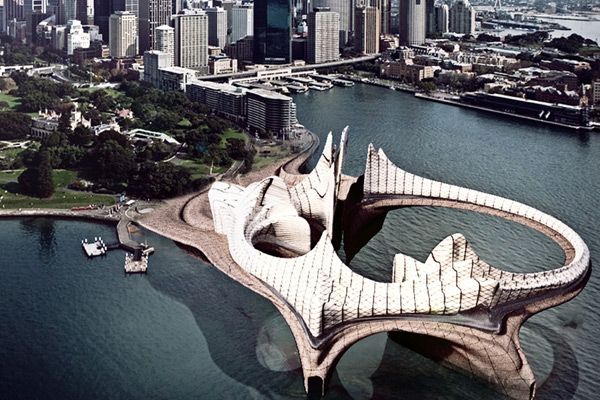
Trigger Image: Minifie van Schaik, Caught Unawares, 2013, Sydney, New South Wales, Australia. Digital reconstruction by Ben Juckes. Courtesy: felix.
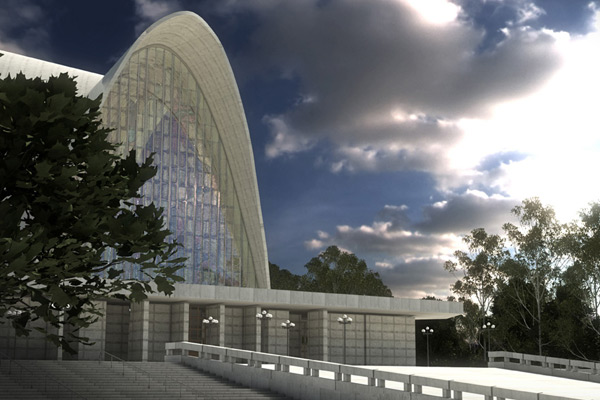
Those with the Augmented Australia app will be able to interact with a suite of virtual material by simply pointing their handheld smart devices at trigger images either in print or on screen. Users will also have the opportunity to seek out and “walk through” a real-world scale model of an unbuilt cathedral that has been geographically positioned in Brisbane, Sydney, Melbourne, Canberra and Perth. ‘The app is still under development so it quite raw at this stage, but it is really exciting to see how far we have come in creating a totally immersive experience using augmented reality technology,’ said Professor Rene Van Meeuwen, Director of felix. ‘We wanted to provide Australians with an opportunity to engage with this technology and get a taste for what we will be showcasing in Venice.’
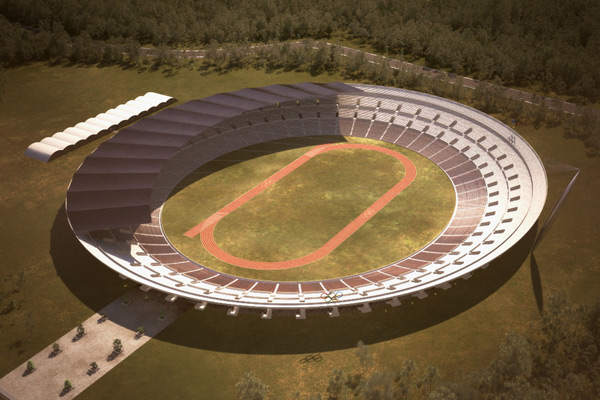
Trigger Image: Harry Seidler, Olympic Stadium, Princes Park, Melbourne, Victoria, Australia. Competition Entry 1952. Digital Reconstruction by Daniel Giuffre and Paul Sawyer. Courtesy: felix.
The Augmented Australia exhibition at Venice will showcase 11 historical and 11 contemporary Australian projects from the past one hundred years, which for various reasons, were never built. It will also bring to life the new Australian Pavilion by Denton Corker Marshall, while it is still under construction in Venice. Australia’s temporary pavilion for the exhibition, known as the Cloud Space, will house trigger images of each project and form a physical portal to Augmented Australia, while real-‐world scale 3D models will be geographically positioned around Venice. Australian Pavilion Commissioner, Janet Holmes à Court, AC, says the exhibition provides an opportunity to construct a bridge between architecture and the public by demonstrating the process, time and alternatives behind significant public works, and a chance to give archived material new life. ‘This is a groundbreaking exhibition that tells the story of Australia’s architectural heritage as never before through reimagining and hi-‐tech innovation,’ she said.
The Augmented Australia exhibition will be open to the public throughout the 14th International Architecture Exhibition from 7 June to 23 November, 2014.
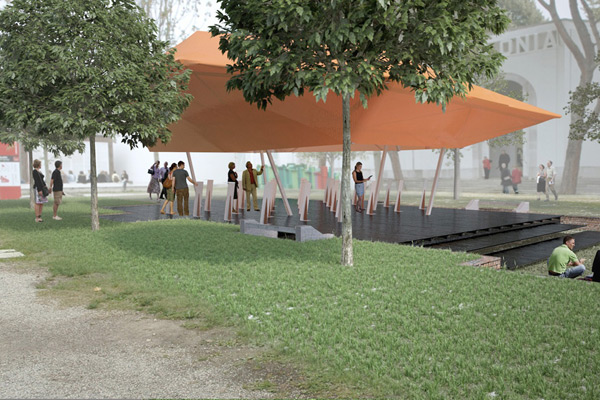
Sophie Giles, University of Western Australia, Cloud Space, Australian temporary pavilion, 14th International Architecture Exhibition – la Biennale di Venezia.
Instructions for utilising the Augmented Australia app:
1. Download the ‘Augmented Australia’ app from the App Store (for iOS) or Google Play (for android)
2. Open the app on your handheld smart device and select either ‘Start 2D Triggers’ or ‘Start Geo Triggers’
3. If you select ‘Start 2D Triggers’, simply point your phone at one of the trigger images (either on your computer screen or in print). A suite of virtual material will automatically appear. Ensure your device has the sound switched on to listen to the voiceovers.
4. To utilise ‘Start Geo Triggers’, you will need to be situated in a central location of one of the following cities: Brisbane, Sydney, Canberra, Melbourne or Perth. The device will ask to detect your location. Select yes. A ‘radar’ icon at the top left hand side of the screen will show the direction of the model by a yellow dot. By moving towards the dot, you can see the full-‐scale cathedral and “walk through” the building, viewing it from the outside and inside.
Hero Image: Pier Luigi Nervi, Antonio Nervi, Carlo Vannoni and Francesco Vacchini, Cathedral, Abbey and Benedictine Monastery, 1958, New Norcia, Western Australia, Australia. Digital reconstruction by Matt Delroy-‐Carr, Keith Reid, Scott Horsburgh. Courtesy: felix.
Augmented Australia
wp.architecture.com.au/venicebiennale
INDESIGN is on instagram
Follow @indesignlive
A searchable and comprehensive guide for specifying leading products and their suppliers
Keep up to date with the latest and greatest from our industry BFF's!
The internet never sleeps! Here's the stuff you might have missed