The home of architecture and design in the Asia-Pacific
Get the latest design news direct to your inbox!

Get the latest design news direct to your inbox!
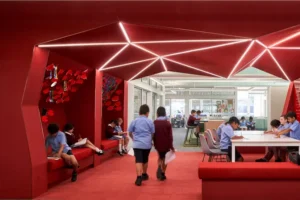
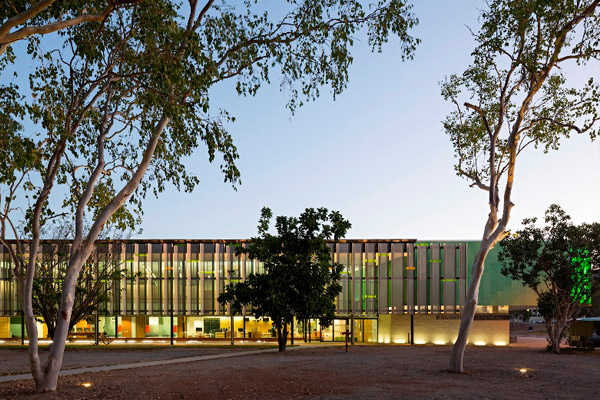
With the increase of remote education options, the importance of physical campuses and direct interaction between educators and students has been called into question. Peter Sackett visits James Cook University’s Student Education Central to explore why physical and social context is still crucial to effective learning.
December 5th, 2013
You could be forgiven for presuming the institution of the university campus — a venerable student-thronged crucible for collegiate social activism, running pants up the flagpole, and other fond memories — is one more quaint relic of the recent past, like supermarket bag boys or paper cheques. Back in 1985, the Val Kilmer comedy/science film “Real Genius” presciently joked about the dawning trend of distance learning with a sequence in which a gaping lecture hall is populated only by tape recorders, both in the seats and at the podium. That scene strikes us as considerably less outlandish today. But there is renewed enthusiasm — and matching doses of prolixity — for bringing people together — physically together — in learning environments.
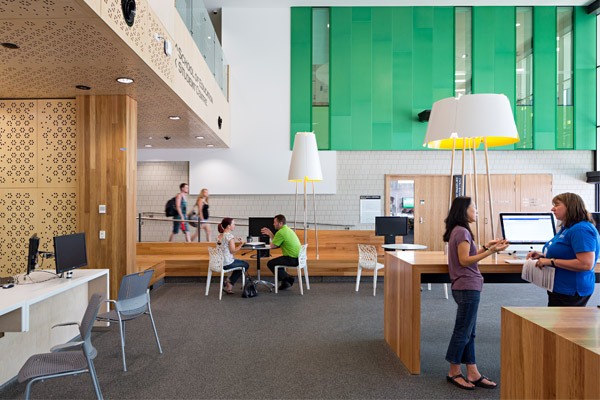
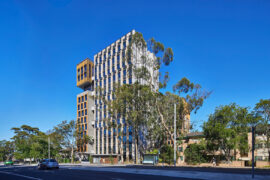
The tough part for a designer, according to Hamilton Wilson, a fourth-generation architect and managing director of Wilson Architects, in Brisbane, is to parse committee-speak and purple prose into something that’s clearly defined first, and take action from there. The firm’s recently completed Education Central building, a three-storey glass and concrete pavilion with gills of metallic brise soleil, at James Cook University, in Townsville, is the school’s hard-earned reward for enlisting an architect willing to guide his client through exercises in remedial thinking.
“We hear all kinds of rhetoric from educators about how one or another learning space can enable certain activities,” Wilson said, “but without genuine understanding of what’s happening in them. They want this kind of space or that kind of space, but there’s no research. I’m more interested in empirical data, and that’s not easy to come by.”
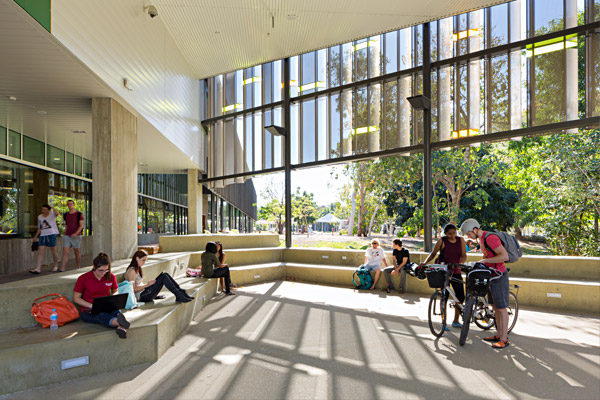
Wilson’s team made extensive enquiries into how students used the learning spaces they already had, including those on JCU’s Singapore campus. What impressed him most were not the facilities themselves (nothing remarkable there) but the “visceral connection”—the physical proximity to one another that students seemed to crave and benefit from. “We’re social creatures,” Wilson stressed.
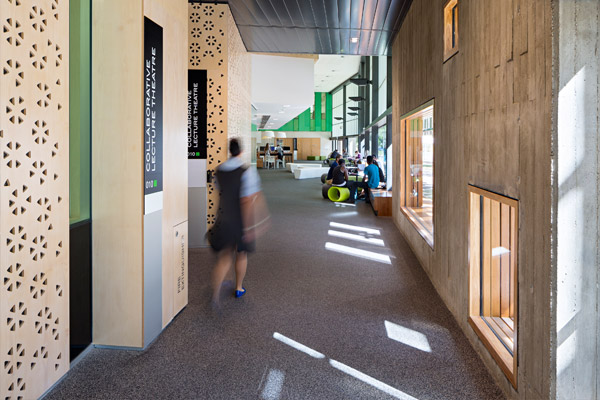
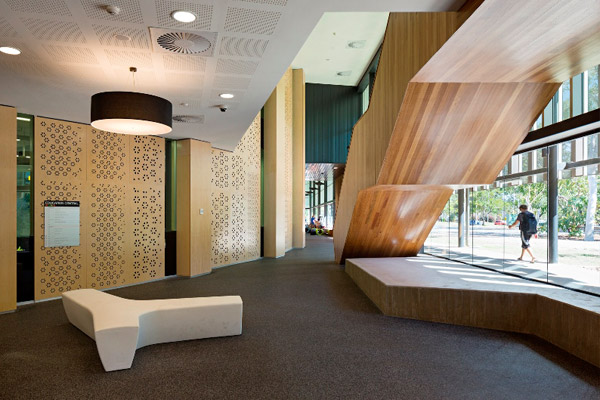
Education Central’s five primary room types have been designed with maximum flexibility as the goal. Each is essentially like the others — loosely organised around work surfaces, and with a shallow-tiered egalitarian topography, but at different scales to host varying group sizes.
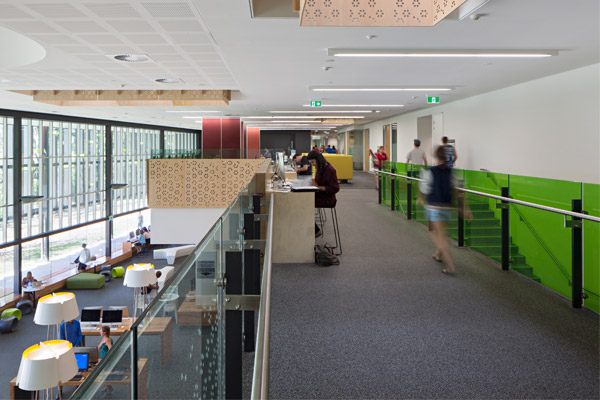
Wilson sees the building not as the overall solution to engaging students in the most constructive ways, but as a new starting point on which the university can build. “But I guess the Holy Grail,” he reflected, “is: have the students learned?”
Wilson Architects
wilsonarchitects.com.au
James Cook University
jcub.edu.au
INDESIGN is on instagram
Follow @indesignlive
A searchable and comprehensive guide for specifying leading products and their suppliers
Keep up to date with the latest and greatest from our industry BFF's!
Australian Living are calling for sustainable homes to be included on an exciting new website. The sustainable housing website will include case studies of sustainable homes in Australia that go beyond 6 stars and are constructed with sustainable building materials. It will act both as a resource and celebration of sustainable homes in Australia. Know […]
The internet never sleeps! Here's the stuff you might have missed
Presented by Stormtech