The home of architecture and design in the Asia-Pacific
Get the latest design news direct to your inbox!

Get the latest design news direct to your inbox!
The Olivia Newton-John Cancer and Wellness Centre (ONJCWC) is a marvellous example of cognitive architecture for enhancing wellness, as Dr. Nicola Davies discovers.
January 30th, 2015
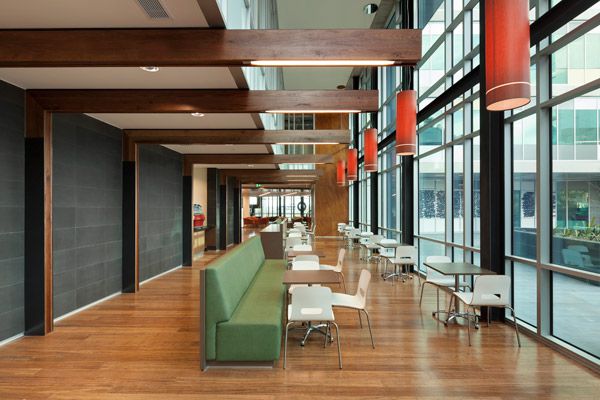
Cognitive architecture is an emerging design system, informed by insights from neuroscience and psychology research. As a system, it takes into consideration that architecture can influence thoughts (cognition), experience and behaviour. For example, lower ceilings, articulated subspaces, and cosy furniture arrangements enhance social interactions. High ceilings with sterile interiors and fixed, single directional seating have the opposite effect.
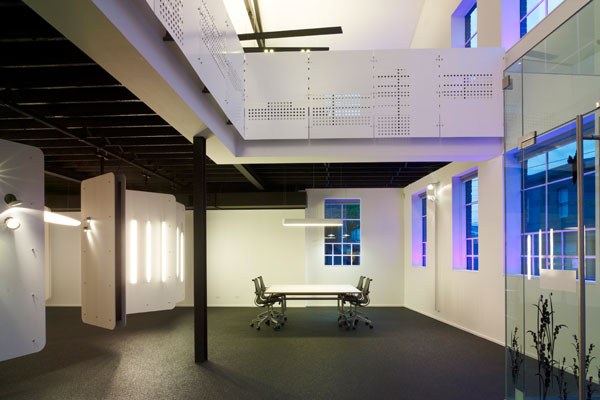
Pendant and indirect lighting give a more residential feel.
Modern neural imaging technology has allowed scientists to see how the brain works while thinking, feeling, and interacting with architecture and built space. Findings from this research can inform architectural design that is aligned with better physical and psychological well-being. Indeed, an understanding of cognitive architecture has been particularly informative within healthcare. Stress is often exacerbated when patients are moved into clinical settings – due to an unknown environment and the sterile, clinical feel of traditional hospitals. A reduction in unnecessary stress resulting from well-designed cognitive architecture can improve patient outcomes.

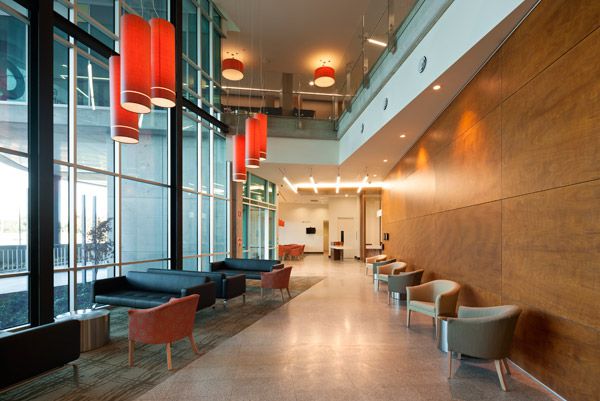
he atrium provides a feeling of space and light and an overall impression of openness.
The ONJCWC, Austin Hospital, Victoria, was designed by McConnel Smith and Johnson Architects and Jackson Architecture as a “facility that delivers cutting-edge clinical care in a tranquil environment that reduces stress on patients, visitors and staff.” The curved facade of the building provides a welcoming feel, “where multi-coloured sunshades filter light and take on a natural connection with the hillside.” Inside, ‘look-out’ lounges are built into curves to give “a 180 degree view of the surrounding landscape.”
Operable, double glazed windows, accessible balconies, and sun-shading screens encourage patient autonomy and provide personalized comfort. Natural light, finishes, colours and textures have been harnessed to bring the feel of the outdoors into the building. The architects say, “The facility offers patients and staff continual access and visual connection to the central courtyard, which is gently wrapped and nurtured by the building façade.” A beautiful, oncology day-room is designed in the form of a huge bay window, looking into the ‘Tree of Life’ in the foreground. In the distance, the Yarra Valley and the Dandenong mountains can be seen. Intuitive navigation through the building minimises anxiety.
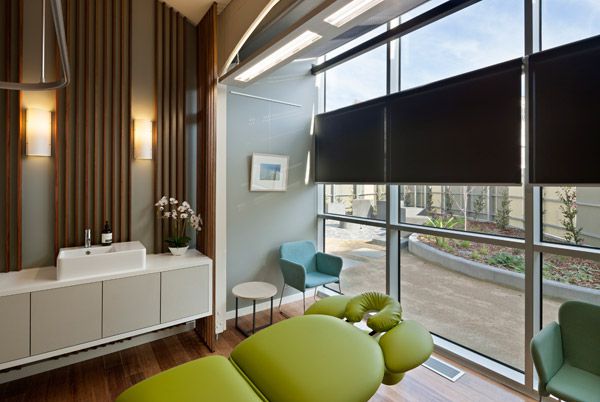
atient lounge overlooking the wellness garden and sun-terrace. Natural light, finishes,colours and textures create a sense of bringing the outdoors inside.
McConnel Smith and Johnson Architects
msjgroup.com.au
Jackson Architecture
jacksonarchitecture.com.au
INDESIGN is on instagram
Follow @indesignlive
A searchable and comprehensive guide for specifying leading products and their suppliers
Keep up to date with the latest and greatest from our industry BFF's!
The internet never sleeps! Here's the stuff you might have missed