Advancements in the technology fast outpace the progress of our buildings and designed environments. This has led to an increasing need for future-proofed infrastructure. In the field of workplace design, this has created ‘the agile workplace’, which is characterised by reconfigurable spaces.
An emerging interest in intelligent, bio-responsive environments that are not only supportive of a change culture, but attuned to real-time individual needs and personal preferences, is now expanding the idea of ‘workspace agility’ with new possibilities.
.
[Environments] attuned to real-time individual needs and personal preferences [are] now expanding the idea of ‘workspace agility’.
.
At the Agnelli Foundation in Turin, an Internet-of-Things-equipped coworking office designed by Carlo Ratti Associati (CRA) is enabling users to create personal ‘environment bubbles’. Office 3.0’s heating, cooling and lighting can be keyed to individual preferences (inputted through personal mobile devices), creating an ambient bubble for each worker that then ‘follows’ them around the building. Each bubble corresponds to a workstation, occupying just a few square meters.

The Agnelli Foundation headquarters, designed by Carlo Ratti Associati has a personalised heating, cooling and lighting system, which follows occupants as they move around the building, like an individually-tailored environmental bubble.
Says Carlo Ratti, Founding Partner of CRA and Director of the MIT Senseable City Lab, “Thanks to coworking and more responsive architecture, we can decrease the number of square meters per person – creating a more efficient use of space and a more sociable environment.
“Aggregated data can serve as a testbed for research on the relationship between office design and productivity. In the near future, by analysing statistics on the building’s use, it will be possible to better understand how people behave in a particular space and how this, in turn, can affect well-being and creativity.”
.
“In the near future, by analysing statistics on the building’s use, it will be possible to better understand how people behave in a particular space…” – Carlo Ratti
.
Ratti’s vision for such organic, adaptive architecture shares many parallels with UNStudio’s research in what they call ‘human aware architecture’. Underpinning UNStudio’s research (titled ‘Towards Human Aware Architecture: Environment Assisted Learning and Working’) is the belief that the comfort and well-being of an individual correlate to both the creativity and productivity of staff and the general efficiencies of a work culture.
UNStudio posits that the homogeneously designed workplaces of today are inadequate in meeting the divergent needs of staff or community, as such individuals are offered little latitude in adjusting their personal spaces.
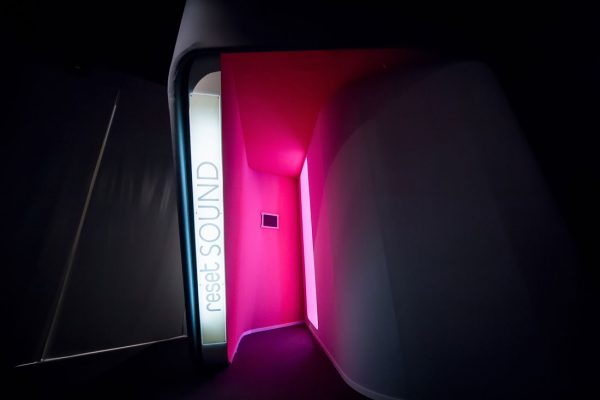
UNStudio proposes that an intelligent, self-learning environment that responds specifically to an individual’s mental and physical state through bio-responsive systems could be introduced to our workplaces.
The proposal is for an EALW or ‘Environment Assisted Learning and Working’ system that would comprise elements such as walls, windows, chairs, desks and even drinking glasses.
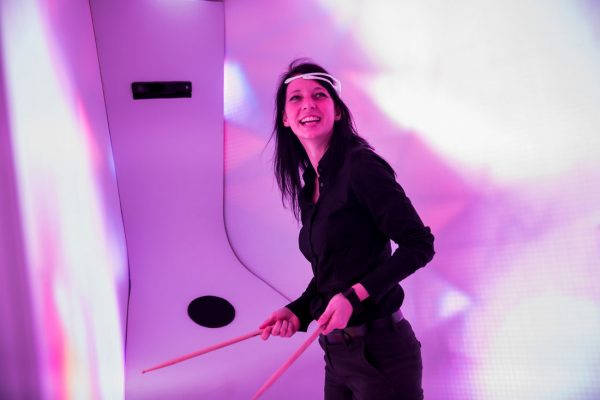
In conjunction with Dutch social design company Scape, UNStudio presented a prototype for an EWAL environment in 2017 in the form of RESET (Responsive Emotional Transformation) – a series of immersive modular pods offering scientifically proven stress-reduction methods.
.
RESET is a series of immersive modular pods offering scientifically proven stress-reduction methods.
.
This excerpt is taken from our Singapore publication CUBES, issue #90. Want to see other experiments in digital? UNStudio also uses digital fabrication to great effect.