The home of architecture and design in the Asia-Pacific
Get the latest design news direct to your inbox!

Get the latest design news direct to your inbox!
Rem Koolhaas of OMA reflects on the changing dynamics of architecture in the age of globalisation. Olha Romaniuk writes.

February 2nd, 2016
It was the conversation about the so-called ‘cultural revolution’ and the blurring boundaries of the East and the West that commanded much of the anticipated talk on art, space and social contract in the current urban condition, between Michael Schindhelm, cultural advisor and filmmaker, and Rem Koolhaas, architect and partner at OMA, at this year’s ArtStage Singapore. With Koolhaas, the visionary behind such projects as the CCTV Headquarters in Beijing and West Kowloon Cultural District in Hong Kong, providing a commentary on the evolving concept of the ‘contemporary city’, the conversation raised important questions about the changing paradigms of the East and the West and the role of architecture in the age of globalisation.
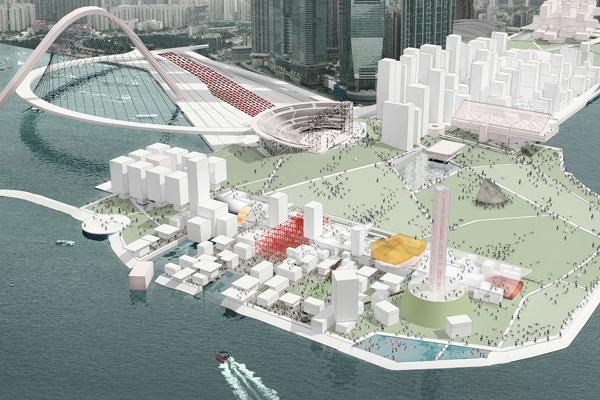
West Kowloon Cultural District in Hong Kong
“The whole idea of a modern city is no longer a Western but an Eastern idea that is being defined on its own terms. This is the new reality,” said Koolhaas, openly conceding that the Western social model is no longer the exclusive domain.
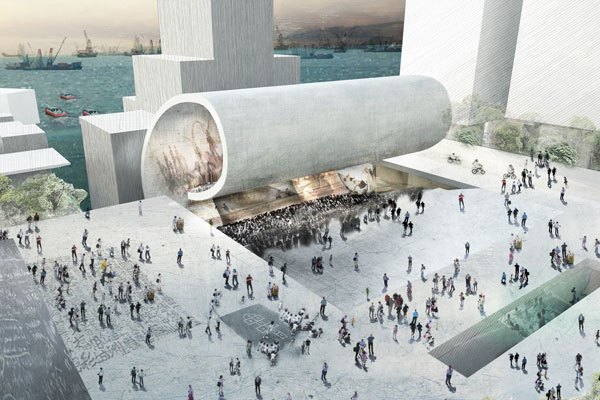
West Kowloon Cultural District in Hong Kong
Koolhaas, who lived in Indonesia for four years as a young boy and who continues to work on projects in Asia, provided an astute view of the contemporary paradigm in which the Western model of a city has become an outdated idea that no longer applies to emerging urban developments of the new century. In this respect, the discussion of architecture as having a universal, rather than a Western, focus zoomed in on cities like Tokyo, Beijing and Singapore, as developing at their own pace and evolving according to their own set of principles.
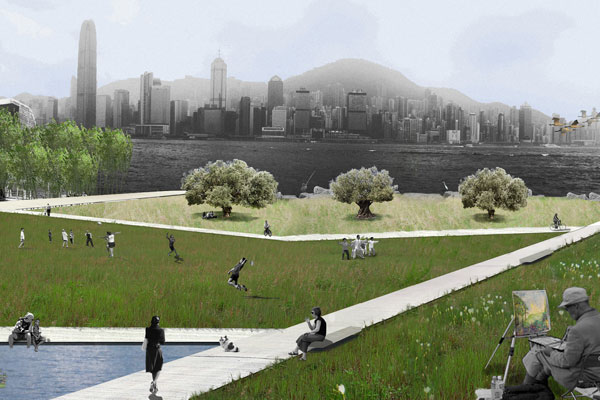
West Kowloon Cultural District in Hong Kong
With the focus on Asia, the inevitable part of the discussion concentrated on the distinction and blurred boundaries between the public and the private and the role of architecture within the public sphere in the East. With Koolhaas having faced criticism over OMA’s involvement with the Chinese government in the CCTV Headquarters project in the past, Koolhaas resolutely endorsed his participation in the controversial state-led project, reaffirming the importance of architects’ involvement in landmark government projects to create positive change.
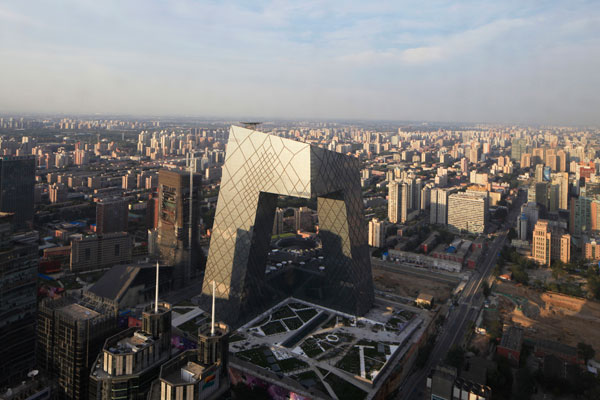
CCTV Headquarters in Beijing
Said Koolhaas: “It is a good thing to participate in a, maybe, controversial, or dangerous, or important way by engaging in government-led projects. Only by participating on that level can we hope that there will be any kind of interaction or effect for architects or the public at large.”
Tackling the universal subject of public versus private in the context of Asia, Koolhaas spoke about the importance of the architect’s involvement in public projects to facilitate the connections between state-led initiatives and the needs of the public at large. Koolhaas referred to several noteworthy examples, including the efforts of the Japanese government in the 1960s to involve architects like Toyo Ito in generating ideas that focused on modernising Japan.
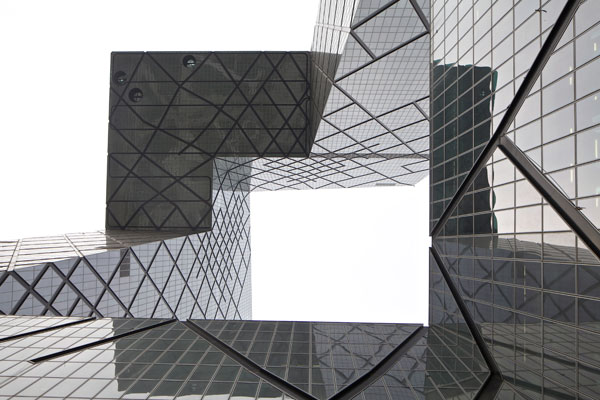
CCTV Headquarters in Beijing
As part of the discussion, Koolhaas’ 1995 essay “Singapore Songlines: Portrait of a Potemkin Metropolis… Or Thirty Years of Tabula Rasa” in his book S, M, L, XL resurfaced as an important point of contention, as the architect himself conceded that he wrote about and studied Singapore as it was one of the most extreme examples of top-down approaches to urban planning and architecture. Far from resorting to criticism, Koolhaas shared his thoughts on the design of the city-state as being an innovative example of a government-led initiative, where the entire island was conceived as “a project and a work of art.”
To one of Schindhelm’s concluding questions – is there, thus, a new society emerging where the blurring boundaries of public and private supersede traditional Western models – Koolhaas’ answer was to stop the comparison between the East and the West all-together. He spoke, in the context of Singapore: “If you talk about a new society, I see an evolution and emancipation of Singapore. I see an even greater affect of globalisation, a creation of global layers of sophistication. This is the platform where the East and the West are meeting.”
INDESIGN is on instagram
Follow @indesignlive
A searchable and comprehensive guide for specifying leading products and their suppliers
Keep up to date with the latest and greatest from our industry BFF's!
The internet never sleeps! Here's the stuff you might have missed