With the rise of digital technology and its allowances, the dream of the ‘paperless office’ has been stuck in the crosshairs of hope and reality. A dream-world in which filing systems are replaced by the omniscient ‘cloud’ and handwritten signatures are a thing of the past. It may sound ecologically romantic, and incredibly noble, but is it even possible? And, are we really ready for a paperless world?
Sure, the incentive to reduce paper in the workplace has never been greater, more surprising, and more needed. Current statistics show that if the US cut office paper usage in 2007 by 10%, it would have resulted in a saving of over 1.6 million tonnes of greenhouse gas emissions we’re being stifled by today. That is the equivalent of taking 280,000 cars off the road, just to give you a little perspective.
So why is it that after 30 years of discussing the concept, paperless offices are still a dream that have not yet been realised? To pursue the ideal of the paperless office requires more than just the act of substitution. The office worker doesn’t simply replace the piece of paper for a computer screen. To create such a dramatic behavioural change, the industry and the institution has to change with it. As with any habit, the break isn’t an easy one, often requiring a hybrid between the two practices and a state of in-betweeness and indecision during the change-management phase (your HR Manager’s greatest nightmare).
Gone is the ideal of being paperless, replaced (for now) by the concept of the “paper light” office. So, what is the paper light office? Put simply, the paper light office is the sweet spot between the paperless office and the paper-centric one. Taking the best from both worlds, the paper light office still reduces paper usage and print-related costs but maintains the ability for particular written contracts and documents to be filed. At this point, the paper light office is a realistic roadmap en route to the paperless ideal.
So, how can your office become Paper-Light?1. Perform a Paper Audit
Go through your office and address the amount of paper already stored. Consider what can be stored digitally and what needs to be physically printed. Recycle (hey, why not compost!) those files that you no longer need and digitally store those that need to be held. Suddenly, you’ve successfully minimized your ecological footprint, you’ve increased the footprint of your workspace, and you’ve disburdened your entire team from continuing to slave under mountains of paper.
2. Managed Print Services
Managed Print Services have the ability to reduce print related costs by an impressive 30%. By evaluating and adjusting company printing services and layouts, MPS is an easy way of reducing company costs and paper use.
3. Cloud Computing
Cloud computing solutions such as Microsoft Office 365 make it easy for offices to digitally file, store and share documents within their chosen platform. With the ability to collaborate between co-workers digitally, the need for printed documents is heavily reduced. Users are also able to save multiple backups of important documents, an act many find to be safer and more effective than a hard paper-copy of a document that could be easily lost.
4. Paperless Billing and Faxing
Another simple solution is to digitally send and store payslips and receipts when possible. Often utilities receipts and bank statements are unnecessarily printed when they could be otherwise stored digitally. There are also options for faxes and printed slips to be able to emailed to you as a pdf instead of needing to be physically printed.
And… do it today!
Integrated technology, intelligent and space saving design solutions, as well as an increased level of knowledge in this space for us all, means that the crusade against paper can start today. By going paper-light, not only do you reduce the need for storage-driven furniture, but you also free up a significant degree of square-metreage in your office space – highly needed in a market where real estate expenditures are through the roof! Krost’s Spine Unit System (pictured) follows this line of problem-solving, providing the end-user with a degree of storage for personal items and work documents within arm’s reach when the larger storage systems are no longer required. The Spine Unit can be configured to suit each employee’s needs, from open shelving to pull-out drawers with an in-built filing capacity, accompanied by sliding or tambour doors.
Alongside the continued rise of ABW models, going paper-light has not only become a desire – it’s become a necessity. Employees who routinely change work areas daily (or even several times throughout the day) cannot afford to be lugging about reams and reams of paperwork with them to each workstation. For those considering making the jump to ABW, embracing a paper-light workplace design philosophy will not only ensure the transition is a welcome and easy one, but an absolute life saver. Recently, the team at Krost made the move to paper-light working by implementing cloud-based systems where staff can work in literally any of the several working areas of their extensive office (from the open areas, to quiet rooms, meeting rooms and even the showroom with the clients).
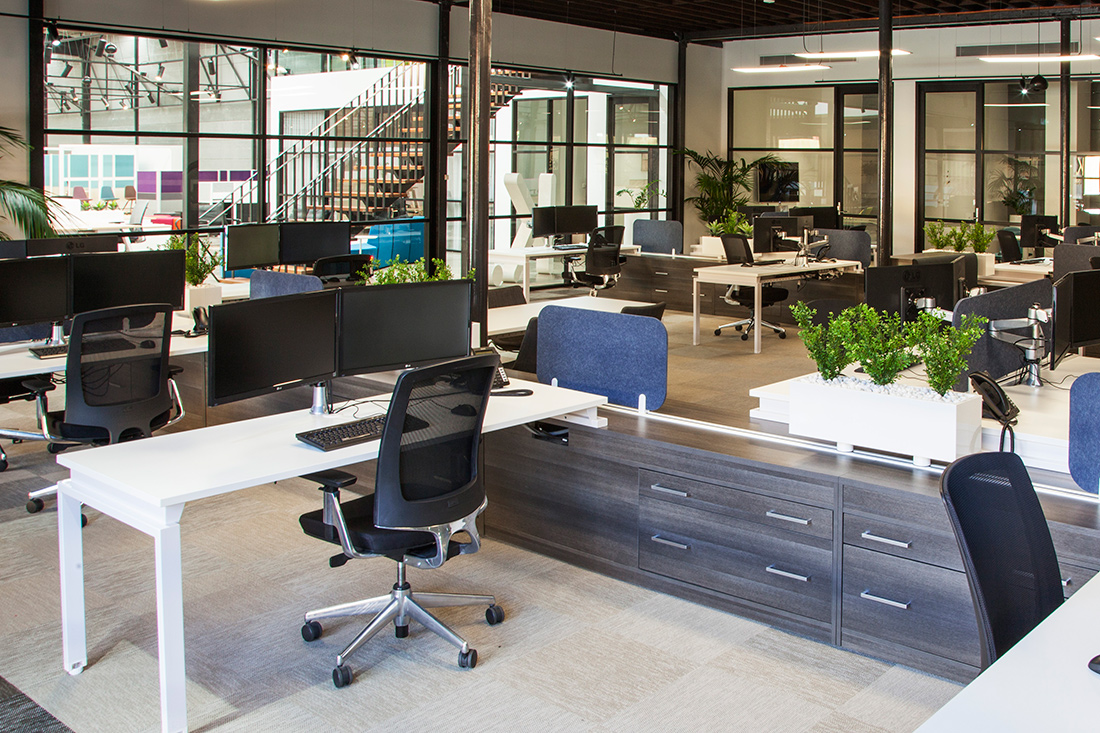
Meanwhile, the call for more intelligent tech solutions further offer the end-user paper-free or paper-minimal design alternatives to traditionally paper-heavy working models. Krost’s Logic Monitor (pictured) eschews the need for printed documents by allowing individuals to set up multiple screens (up to 6 at once) on the one desk. Eliminating the need to print documents – by allowing end-users to work of 6 or more digital documents simultaneously – the design also ensures that workers can enjoy an uncluttered, visual workspace that celebrates flexibility, first!