In the contemporary world of design, most designers look to the newest trends for inspiration. Job Smeets and Nynke Tynagel of Studio Job however, would rather look to the past. Heraldic and traditional icons feature in their oeuvre, which mainly consists of unique pieces for art galleries and private collectors. Selected collaborations with brands like Swarovski, Bisazza, Venini and Moooi have also resulted in pieces that straddle the art and design world.
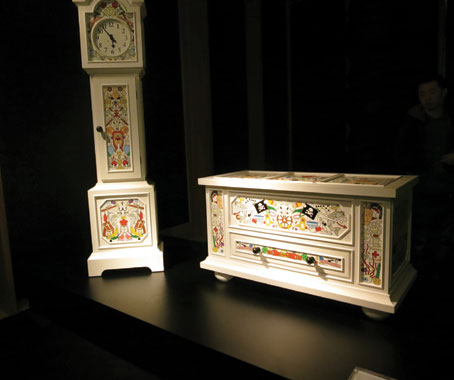
‘Altdeutsche Mobel’ (2012) is a new collection for Moooi comprising a clock, wardrobe and chest-of-drawers
Tell me about your new designs for Moooi this year.
Nynke Tynagel (NT): We were in Germany last year and we visited a museum and saw the hand-painted German furniture – ‘Altdeutsche Mobel’. We got inspired by them and made a contemporary version of them. They’re also hand-painted pieces, painted by Chinese artists.
Job Smeets (JB): The original ones were produced by the German farmers themselves in the 17th century.
How did you decide what kind of graphics to put on the surface?
NT: It’s a mix of types of graphics we use, new ones…
JS: They’re like tattoos…
NT: … like words combine together to make stories. You have the icons you put together in a certain [pattern].
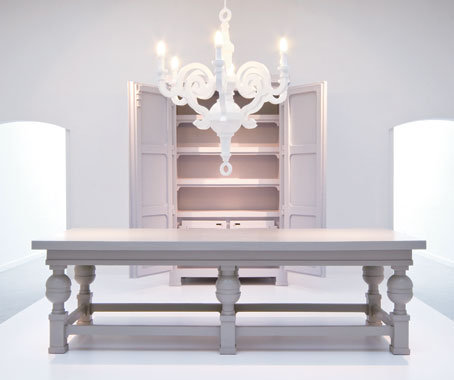
The ‘Paper’ collection (2009) for Moooi is made from wood, cardboard and strong PU lacquer finish
Do you find it ironic that despite the commentary of your work on the importance mankind places on material things (or at least, that is what some of your works come across as saying), that a lot of your pieces are exorbitantly priced as art and desirably collected? Is it okay that people pay a lot for ideas but not daily material things?
JS: We materialise or translate commentary into exclusive objects…
NT: In a way we tempt the viewer with his/ her own weaknesses…
JS: …like the ancient Ouroboros symbol of the serpent eating its own tail.
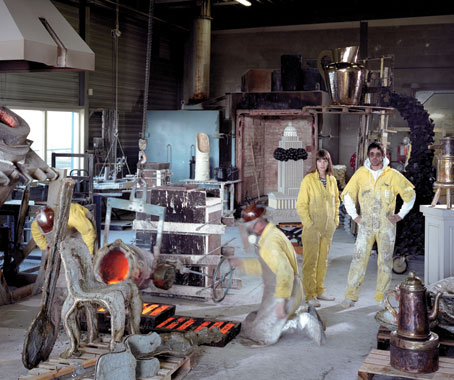
Smeets and Tynagel in the foundry
What are your thoughts on the media and design?
JS: It’s a business eh? It’s a business model. For us it’s a blessing and a curse. So much media attention is good to determine our identity, but nowadays it can also distract [us] from the work so we try to focus more on the work and less and less [on becoming] public people.
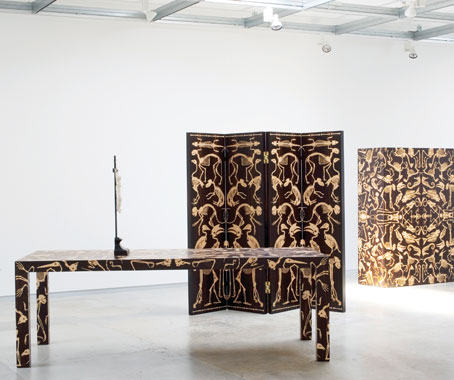
The ‘Perished’ collection (2006) applies icons of extinction, destruction and death onto traditional Flemish furniture with delicate marquetry craft
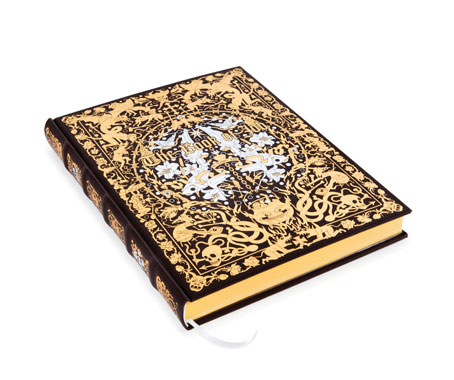
‘The Book of Job’ is Studio Job’s biblically inspired monograph (Rizzoli, 2010)
Julian Treger, in your monograph, mentioned that your work is both ‘easy on the eye and hard on the soul’. You’re not afraid to broach the subversive topic of death in collections like ‘Perished’ for example. What are your personal thoughts about death?
NT: Death is the most tragic part of our lives. Life and death are extremely strong icons… very inspiring and visually interesting!
JS: Without death there would be no life. It combines us with all lives on our planet.
NT: When choosing topics we want to be totally free and honest.
JS: No taboos since boundaries are bad for culture, creation and expression.
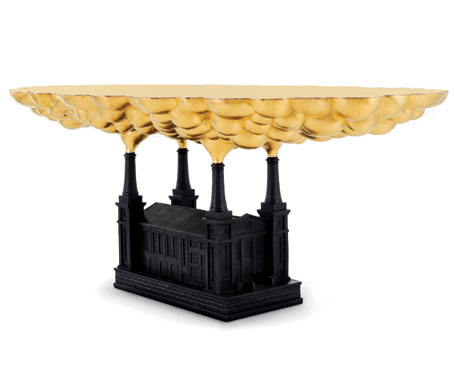
The ‘Robber Baron’ collection (2007) comments on “the outrageous excesses of America’s 19th century tycoons and Russia’s new oligarchs”
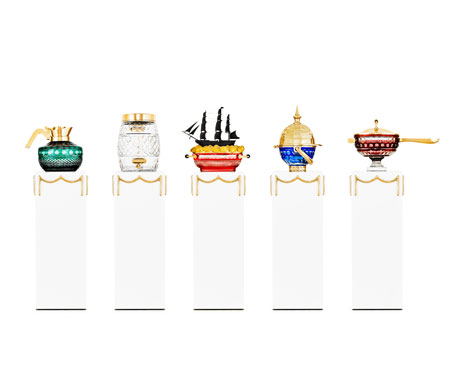
Unfinished pieces found in the storage of Belgian crystal producer Val Saint Lambert were completed in the ‘Containers II series’ (2011)
Some of your works have cynic underlying tones. In another interview, you have mentioned that you think “we are living in some kind of Middle Ages.” Is there hope in these times (the design field and otherwise) and is there any inkling of hope in your messages or are they all cynical?
NT: In times of low economics, which is definitely the case in Europe, it’s unsexy to be cynical.
JS: Also, personally I don’t feel the work is overall cynical.
NT: You’re right; other aspects feed the work. Surrealism and symbolism are important!
JS: The work is figurative, expressive, sculptural…
NT: Overall we have a romantic, nearly classical approach. Our work is not about positivism…
JS: … nor about minimalism in the modernistic sense. Anyway, being realistic doesn’t mean that you are cynical!
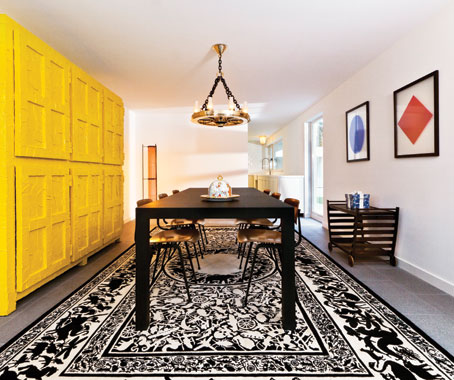
Opened in 2011, the Studio Job House displays the works of modern Dutch and Belgian designers and Studio Job’s pieces
Top image: The design duo in front of their ‘Biscuit’ collection (2007) of ceramics for Royal Tichelaar Makkum
Photography: R. Kot, D. Stier, K. Vrancken
For the complete interview, get your copy of Cubes issue 56 out now at Singapore newsstands.