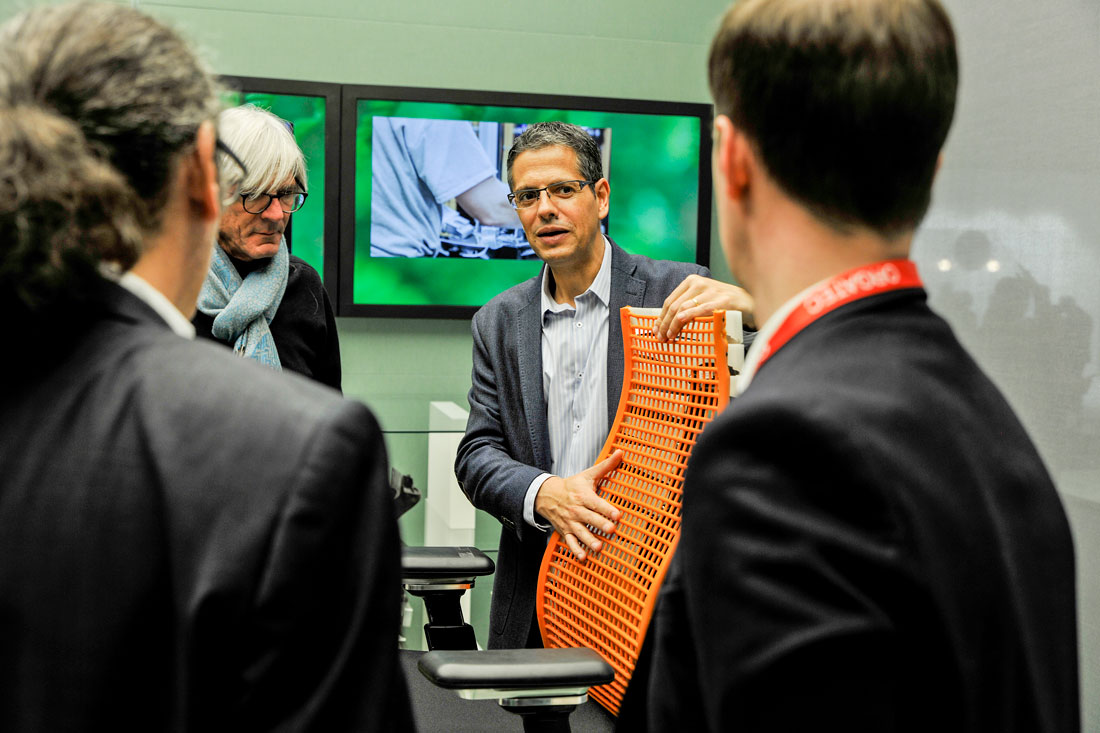
‘Happiness’ can be difficult to define and explain, yet we all intuitively understand its value. In particular, it is something that employers should be paying attention to in conjunction with today’s focus on employee engagement. That is the opinion of Dr Mike O’Neill (pictured), the leader of the workplace research department at Haworth, whose investigations into engagement have led to a significant international study on happiness at work.
“Employee engagement is a good thing, but really, companies want their employees to be engaged because they want them to stay,” he said at the Haworth stand at Orgatec 2016, after delivering a seminar titled ‘Workspace Design and the Pursuit of Happiness’. “When I first started looking at happiness, I thought it was just a fleeting emotional state. But the more I understood it, the more I saw how it’s connected to health and meaningful work. Even money doesn’t motivate people past a certain point,” he noted.
Fuelled by Dr O’Neill’s preliminary research, Haworth is currently undertaking a large global study to find out more about what drives happiness at work. To date, over 2,000 individuals from eight diverse locations (from the USA to Central America to China) have rated the details of their individual workspaces and aspects of their overall happiness.
The findings are indicating that happiness is affected by two key aspects of the work experience: the ability to focus, and the feeling of being valued. “These two factors don’t tell us how to design a space though. So we conducted more analysis to find out which design features actually [contribute],” explained Dr O’Neill during the seminar.
It emerged that spaces with good legibility and that workers are able to control lead to greater focus and the feeling of being valued. Furthermore, the better the space supports the use of technology, provides access to daylight and offers usable storage, the more valued employees felt. Thus Dr O’Neill has defined five design features as being significant to feelings of happiness at work. Collectively, he calls them a ‘design language for happiness’.
Applying those design features is something we can all do now, he suggested. Designing for the legibility of space (the first element) simply requires laying out the space in a way that lets people understand it quickly and find their way to different locations easily. User control (the second element) can be encouraged with adjustable furniture, the provision of the appropriate work tools (such as whiteboards), and giving people a choice about their work location. Good technology support and integration (the third element) involves having the right technology and the right furnishings to support the use of that technology. Access to daylight (the fourth element) can be achieved by lowering the horizon lines within the building, planning for proximity to windows, and using window walls in deeper areas of the floor plate to transfer daylight all the way to core of the building. Storage and display elements (the fifth element) can be easily integrated into individual workstations as well as unassigned spaces.
“We need to start thinking about this more seriously,” he concludes. “Ultimately, if we can do these simple things in a coherent fashion to increase people’s feelings of being valued and being able to focus at work, people will be happier. Happiness is a goal that’s ultimately going to drive things that companies care about, like engagement and health. If we can increase happiness and engagement, the outcome will feed back into health. There’s a positive cycle we can get going.”
Photography by Marc Theis