The home of architecture and design in the Asia-Pacific
Get the latest design news direct to your inbox!

Get the latest design news direct to your inbox!
A young Sydney-based architect has been chosen to design London’s newest urban park. Ben Morgan speaks to Andrew Burns about the upcoming project in London Bridge.
May 23rd, 2012
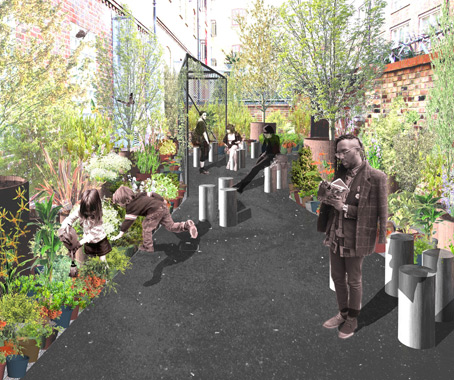
London is a vibrant city, where a vast array of cultures, professions and socio-economic groups live, work and play together. This brings with it its own set of challenges.
When emerging Sydney-based architect Andrew Burns was invited by the UK’s Architecture Foundation to develop a design proposal for an existing uninspiring laneway in London Bridge, he knew it was an opportunity to create a sense of community.
“It’s really about trying to create a way for quite an innovative community participation,” Burns says.
“When you think about community participation there’s often this sense of compromised design. To me, this project tries to find the sweet spot between a participatory project and design excellence.”
Burns’ winning scheme uses compression and decompression of spaces along the ’higgledy-piggledy’ cut-through, to create interest and define space.
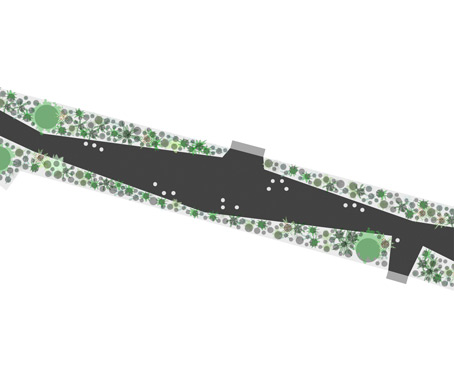
“It’s a strange, contorted laneway, because it’s a cut-through behind the buildings.”
“We established this geometry, which narrows, widens, narrows, widens and so on. It creates this sense of extended space, then compressed space. It’s a very precise architectural figure imposed on the ground, following all the realities of the geometries of the site. Found geometry is a real gift when you’re designing, because it gives you something to spring from.”
Working with renowned English landscape designer Sarah Eberle, the team involved will place around 200 trees and plants into concrete containers around the site, with the remaining 400 or so plants to be contributed by the community.
“It creates some interesting design issues of how you establish a narrative of planting and how you then work with the community to, in a way, embellish that narrative, without being prescriptive,” Burns explains.
“I think, with our generation, there’s an increasing acceptance of informal planting, as opposed to a manicured garden. It’s a significant change – expecting a more humane quality to a city. So this project becomes a bit of a test of that sort of thing.”
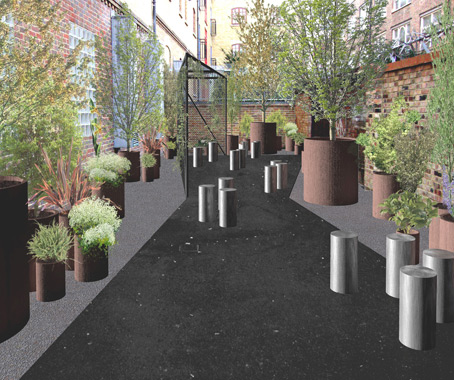
Although the planting will largely be a community effort, the geometry of the site has been defined by Burns, with large wire entry structures ’funnelling’ Gibbon’s Rent visitors into the space, which uses the ’harlequin’ pattern to create asphalt pathways and angular garden zones.
“With this project, a big factor is trust. If we’re placing a whole lot of pots around, you can imagine a client group being quite concerned about someone walking off with a pot, but all the partners are really excited about that; they think it gives it an energy. If a project can stimulate, or raise consciousness of a concept of trust, I think that’s quite positive.”
The garden is designed to become a permanent fixture on the site and will be officially opened during the London Festival of Architecture, 23 June – 8 July 2012. The design was developed in collaboration with Tom Gray and Alan Powell.
Andrew Burns Architect
andrewburns.net.au
The Architecture Foundation
architecturefoundation.org.uk
INDESIGN is on instagram
Follow @indesignlive
A searchable and comprehensive guide for specifying leading products and their suppliers
Keep up to date with the latest and greatest from our industry BFF's!
Who’s Doing What on indesignlive.com is creating a stir. Already we’ve received submissions from NSW and Victorian firms. Now it’s time for the other states to step up and get their projects featured on indesignlive. New entries include: Design Clarity1:1 ArchitectsV-Arc Remember that all projects submitted to Who’s Doing What, will be considered by our […]
The internet never sleeps! Here's the stuff you might have missed